Tyrannosaurus Rex: The Complete Guide to the King of the Cretaceous

tyrannosaurus rex

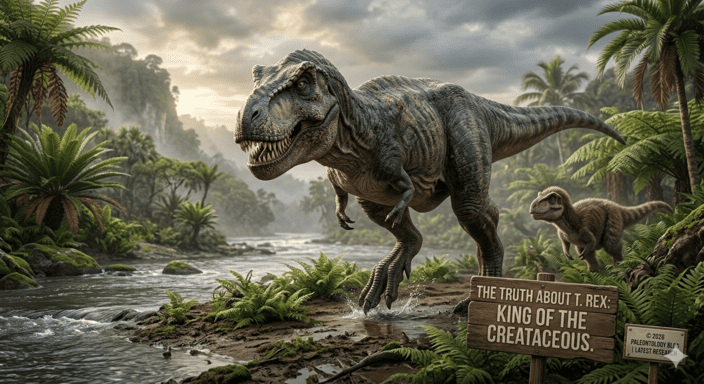
Among the pantheon of prehistoric giants, one name stands above all others: Tyrannosaurus rex. The “Tyrant Lizard King” remains the ultimate symbol of paleontological power and fascination. In the world of 2026 science, our understanding of this apex predator has evolved far beyond the roaring monster of classic cinema, revealing a complex, highly adapted, and surprisingly sophisticated animal that dominated the twilight of the Mesozoic Era.

What Makes T. rex Unique?

The T. rex was a masterpiece of specialized evolution. While other large theropods like Giganotosaurus existed, T. rex optimized one specific strategy: devastating power. Its most defining characteristic was its skull. Unlike the blade-like teeth of its rivals, T. rex possessed thick, conical, banana-sized teeth designed not just to cut meat, but to crush bone.

Engineered for a bite force estimated at 35,000 to 57,000 Newtons—the highest of any known terrestrial animal—it didn’t just bite its prey; it pulverized it, allowing it to access rich marrow that other predators had to ignore.

The Hell Creek Habitat: Rule of Laramidia

T. rex ruled the landmass known as Laramidia, that is now western North America and includes modern-day Montana, South Dakota, and Alberta, Canada. during the Late Cretaceous, roughly 68 to 66 million years ago. Its primary hunting grounds included dense coastal floodplains, open forested regions, and subtropical swamplands, particularly the famous Hell Creek Formation.

It coexisted with, and preyed upon, massive armored herbivore titans like Triceratops and Ankylosaurus, as well as large hadrosaurs like Edmontosaurus. This environment provided the massive amount of biomass required to sustain a multi-ton apex predator.

Behavior and Physical Attributes: A Smart and Social Killer?

Modern paleontology has shattered the image of T. rex as a slow, and as a simple scavenger. New research into endocasts (brain cases) indicates T. rex had a relatively large brain compared to other giant theropods, suggesting complex behaviors.

  • Advanced Senses: Its olfactory bulbs were massive, providing an exceptional sense of smell, while its forward-facing eyes granted excellent binocular vision and depth perception—essential traits for an active hunter.
  • Body: Tyrannosaurus rex was a large carnivorous theropod that walked on powerful hind legs and balanced its body with a long, heavy tail. Adults could reach more than 40 feet in length and weigh up to 15,000 pounds.
  • Teeth: One of its most impressive features was its bite. T. rex possessed about 60 large serrated teeth, some measuring up to eight inches long. These teeth allowed it to crush bone and tear through flesh with incredible force.
  • Social Hunting: Perhaps the most groundbreaking shift in 2026 thinking concerns social behavior. Fossil evidence of multiple T. rex individuals found together in bone beds strongly suggests they may have been social, perhaps even hunting in coordinated packs, particularly when targeting armored prey like Triceratops.

If you want to bring the ‘King of the Tyrants’ into your own home, check out our guide to the most realistic T. rex action figures and collector models of 2026.

Recent Discoveries and Interesting Facts

The last few years have been a golden age for T. rex research:

The Fuzz Fact: While adult T. rex were likely mostly scaly (due to gigantothermy), 2026 paleontology agrees that juveniles were likely covered in a light, downy coat of proto-feathers for insulation and camouflage, which they lost as they grew.

Bite Dynamics: Advanced computer modeling (published in 2025) finally explained how the T. rex skull could withstand its own immense bite force without shattering: its skull possessed key “kinetic” joints that allowed slight flexibility, absorbing the shocking impact of bone-crushing impacts.

The Tail Paradox: T. rex was once depicted with a dragging tail. It is now known that its muscular, heavy tail acted as a necessary counterbalance to its massive skull, held stiffly parallel to the ground for balance and stabilization during rapid turns.

New Beginnings: A 2025 study suggests the species may have evolved in North America after its ancestors migrated from Asia across an ancient land bridge millions of years earlier.

Great Growth: Scientists have also discovered more about how quickly the dinosaur grew. Recent studies of bone growth rings indicate that T. rex may have taken as long as 40 years to reach full size, longer than previously thought.

Tyrannosaurus rex is full of surprising traits that make it unique among dinosaurs:

  • It had one of the strongest bite forces of any land animal in history.
  • Its tiny arms remain a mystery—scientists still debate their purpose.
  • Some of the most famous fossils include Sue and Scotty, two of the largest T. rex skeletons ever discovered.
  • Despite its massive size, it likely relied heavily on smell and vision to locate prey.

Why T. Rex Still Captivates Scientists

Tyrannosaurus rex remains the defining apex predator of Earth’s history because it was a perfect optimization of power, intelligence, and sensory perception. It wasn’t just big; it was exceptionally well-adapted. As we continue to uncover its feathered past and social complexities, the true King of the Dinosaurs only becomes more fascinating.
Everything Dino: A Fun and Fascinating Dino World

everything dino

Everything Dino: A Fun and Fascinating Dino World

Welcome, future paleontologists and dinosaur enthusiasts, to the only website you’ll ever need for everything dino! If you’ve ever gazed in wonder at the sheer scale of a Tyrannosaurus Rex or been captivated by the swift grace of a Velociraptor, you’ve found your digital home. We are passionate about bringing the prehistoric world back to life through engaging content, up-to-date news, and a vibrant community dedicated to these magnificent creatures. Prepare to embark on an incredible journey through time, right from your screen!

Our mission is to be your most comprehensive guide to the Mesozoic Era, covering everything dino from the smallest Microraptor to the colossal Argentinosaurus. We understand the fascination these ancient beasts hold, and we’ve built this site to feed that curiosity. Whether you’re a budding young enthusiast sketching your favorite carnivores or a seasoned expert keeping tabs on the latest research, there’s a trove of information and entertainment waiting for you here.

One of the most popular sections on any dinosaur site often revolves around dino fun facts. These bite-sized pieces of information are perfect for quick learning and sharing. Readers might discover how some dinosaurs had feathers, how long certain species lived, or how paleontologists can estimate a dinosaur’s speed from footprints. Trex fun facts are especially popular, as Tyrannosaurus rex remains one of the most iconic dinosaurs of all time. From its powerful bite force to ongoing debates about its hunting behavior, T. rex facts never fail to impress and surprise.

The fascination with everything dino extends far beyond paleontology and into the vibrant world of media, where these prehistoric giants have captivated audiences for over a century. From the groundbreaking CGI spectacle of the Jurassic Park franchise to the heartwarming animated adventures of The Land Before Time, movies and television constantly reimagine the age of dinosaurs, sometimes with scientific accuracy and sometimes purely for thrill. Beyond the screen, a rich library of dinosaur books—encompassing everything from educational reference guides to speculative fiction novels—continues to fuel the imagination, ensuring the legacy and roar of these incredible creatures live on in popular culture.

For the younger explorers and collectors at heart, we have an extensive section dedicated to dino toys. Dive into reviews of the latest action figures, learn about educational playsets, and discover classic collectibles that bring the roar and stomp of dinosaurs into your living room. We’ll help you navigate the vast array of options to find the perfect gift or addition to your own prehistoric menagerie, ensuring endless hours of imaginative play.

Beyond your personal collection, we track the best places to experience these giants up close. Our frequently updated guide to dino exhibits, dino museums, and dino theme parks will point you towards the most breathtaking museum displays, immersive interactive experiences, and even real-life fossil digs happening near you or around the world. Imagine standing beneath a towering skeleton or seeing a meticulously reconstructed ancient landscape – we’ll help you plan your next unforgettable adventure.

We also keep a keen eye on the cutting edge of paleontology. Our dino discoveries section brings you the latest news from archaeological digs and scientific breakthroughs. Read about newly identified species, groundbreaking theories on dinosaur extinction, and advanced technologies that are helping scientists uncover more about these ancient rulers of Earth. It’s a dynamic field, and we’re here to ensure you don’t miss a single seismic revelation.

So, whether you’re here to find the perfect dino toys, plan your next visit to spectacular dino exhibits, delve into amazing dino fun facts, stay updated on the latest dino discoveries, or simply immerse yourself in everything dino, you’ve arrived at your ultimate prehistoric portal. Explore, learn, and let your imagination roam freely across millions of years of Earth’s most incredible history!

Dino Fun Facts That Will Surprise You

dino fun facts

Dinosaurs, those magnificent creatures of the past, have captivated our imaginations for centuries. While we often think of them as enormous, fearsome beasts, the world of dinosaurs is also filled with surprising, quirky, and downright fun facts that will make you look at them in a whole new light. Get ready to stomp through some of the most enjoyable tidbits about these prehistoric giants!

The very atmosphere of the Earth was different during the Mesozoic Era. Because the planet was much warmer and had higher levels of carbon dioxide, plants grew at an explosive rate, providing a nearly endless buffet for herbivores. This “supercharged” vegetation is part of what allowed dinosaurs to reach such gargantuan sizes. Furthermore, the days were actually shorter! Because the Earth’s rotation has been gradually slowing down due to the moon’s tidal pull, a day in the late Cretaceous period lasted only about 23.5 hours. If you were a dinosaur, you’d have had 30 minutes less in your day to hunt or forage than we do now.

Here’s a mind-boggler: the word “dinosaur” itself means “terrible lizard,” coined by Sir Richard Owen in 1841. However, many dinosaurs weren’t actually lizards! They belonged to a separate group of reptiles with unique hip structures. And while some had scales like modern lizards, the many feathered dinosaurs mean they were far from just scaly beasts. Fossil discoveries, especially in China, show that many dinosaurs, in fact, are closely related to birds. These feathers were not just for flying as they may have helped with temperature control, display, or camouflage. This discovery has completely changed how scientists and artists imagine dinosaurs, moving away from scaly reptiles to more bird-like creatures.

Did you know that not all dinosaurs were massive? While giants like Brachiosaurus and T-Rex often steal the spotlight, many dinosaurs were actually quite small. One of the smallest known dinosaurs, Compsognathus, was only about the size of a chicken! Imagine a tiny dinosaur scurrying around, perhaps even making a cute little chirping sound. These miniature marvels remind us that diversity in size was just as prevalent in the Mesozoic Era as it is today.

Let’s talk about speed. While some dinosaurs were undoubtedly fast, like the agile Velociraptor, the slowest dinosaur might surprise you. Some of the colossal long-necked sauropods, due to their immense weight and limb structure, would have moved at a ponderous pace, maybe only 2-3 miles per hour. Imagine a giant, slow-motion parade of these gentle giants munching on leaves!

Science is constantly discovering more about the dinosaurs day to day life. For instance, we often find “gastroliths” inside dinosaur fossils—smooth, polished stones that the animals swallowed on purpose. Since many dinosaurs didn’t have the right kind of teeth to chew tough plant matter, they used these stones in a “gizzard” to grind up food in their stomachs, much like modern crocodiles and chickens do today. This internal rock-crusher allowed them to process massive amounts of ffood. Also, fossilized teeth show signs of decay and infection, meaning some dinosaurs suffered from toothaches just like humans do. Who knew that even dinosaurs could get cavities?

Dinosaurs also lived on every continent, including Antarctica. Fossils found in polar regions show that some dinosaurs adapted to extreme environments, dealing with long periods of darkness and cooler temperatures. This proves dinosaurs were far more adaptable than once believed, thriving in deserts, forests, coastal regions, and icy landscapes.

Another fun fact is that dinosaurs laid eggs, and some species cared for their young. Fossilized nests and eggs suggest certain dinosaurs protected their offspring and may have lived in family groups. This behavior brings dinosaurs closer to modern birds and challenges the idea that they were cold, mindless reptiles.

Dino fun facts also extend to how dinosaurs communicated. While we can’t know exactly what sounds they made, scientists think some dinosaurs used deep calls, body movements, or even bright colors to communicate. Crests, horns, and frills may have played a key role in display and social interaction. New research suggests that they might have even done mating dances similar to many species today.

These dino fun facts show that dinosaurs were complex, intelligent, and incredibly diverse. With new discoveries happening all the time, the prehistoric world continues to surprise us, proving there’s always something new to learn about the giants that once ruled the planet.

While these prehistoric giants were certainly impressive, some of them were stuck with titles that are more hilarious than heroic—check out our list of the most ridiculous and funny dinosaur names ever discovered to see which ones really got the short end of the stick.”