For decades, Spinosaurus was a mystery, known primarily from fragmentary fossils destroyed in World War II. But thanks to incredible new discoveries and re-evaluations over the last decade (especially prominent in 2026 paleontology), this North African behemoth has not only claimed the title of the largest known carnivorous dinosaur, but also completely rewritten the rules of how we thought giant predators lived.
More Than Just a Giant: The True Face of Spinosaurus
While Tyrannosaurus rex and Giganotosaurus ruled terrestrial landscapes, Spinosaurus aegyptiacus dominated the ancient river systems of what is now North Africa. Reaching lengths of 14 to 15 meters (45-50 feet) and weighing between 7 to 12 tons, it was longer than any other known predatory dinosaur. But it wasn’t just its size that set it apart; its entire anatomy screams “river monster.”
A Hunter Unlike Any Other: Semi-Aquatic Adaptations
Forget the upright, land-dwelling monster from the movies. Modern research, fueled by the discovery of a near-complete skeleton, reveals a creature uniquely adapted to an aquatic lifestyle:
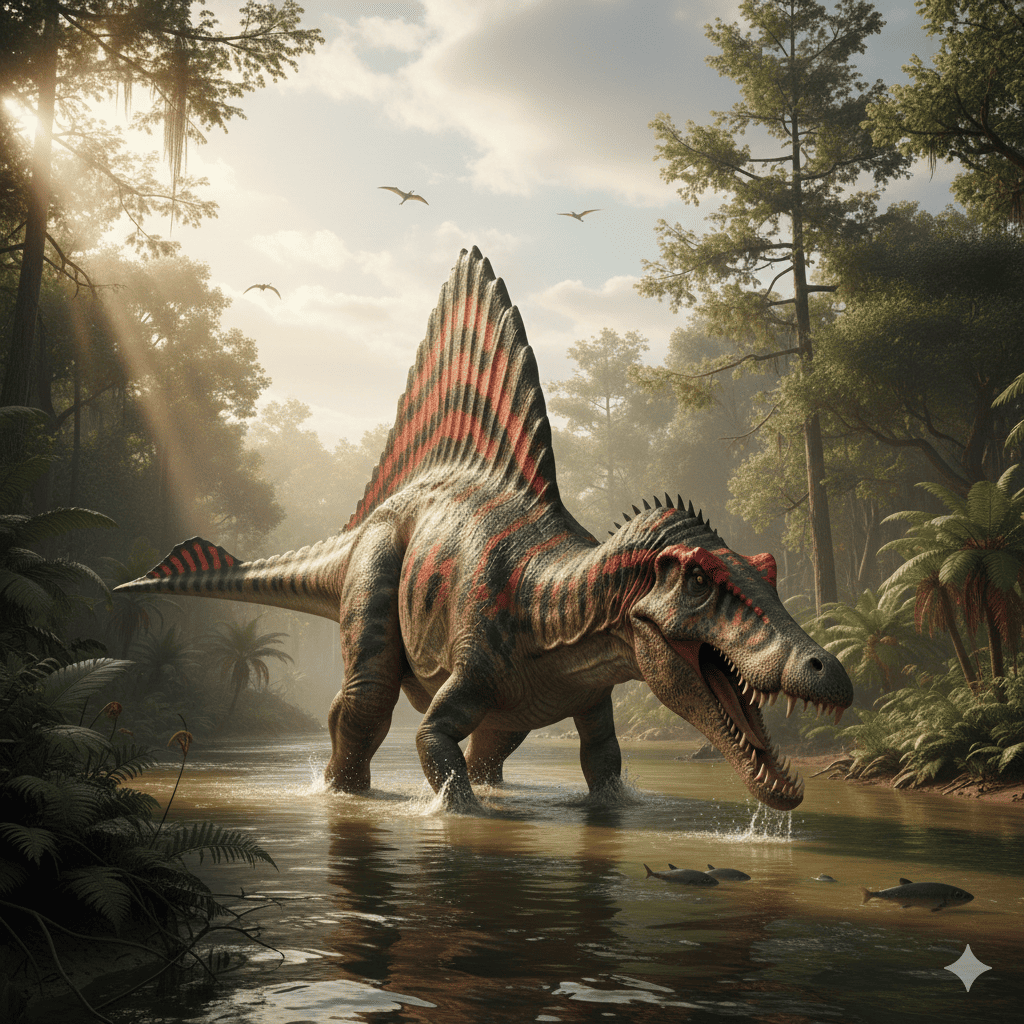
- Crocodile-Like Snout: Its long, narrow jaws were packed with conical, non-serrated teeth—perfect for spearing slippery fish, its primary diet.It’s nostrils were set farther back on its snout, an adaptation that suggests a semi-aquatic lifestyle.
- Massive Dorsal Sail: The iconic sail, supported by neural spines over 1.6 meters (5 feet) tall, was likely used for display, but its function is still debated. It certainly didn’t hinder its movement in water. Scientists believe this sail may have been used for display, temperature regulation, or species recognition.
- Dense Bones & Short Hind Limbs: Unlike land-based predators with hollow bones, Spinosaurus had dense bones, acting as ballast to help it submerge and maneuver underwater. Its relatively short, powerful hind limbs were better suited for paddling than for sustained running on land.
- Paddle-Like Tail: The most game-changing discovery came with the reconstruction of its tail in the late 2010s and early 2020s. It was broad, flexible, and paddle-shaped, confirming its ability to propel itself powerfully through water, much like a crocodile or newt.
The Apex Predator of the Rivers
Spinosaurus wasn’t just splashing around in the shallows; it was the undisputed apex predator of its unique ecosystem. It coexisted with other large predators like Carcharodontosaurus and Deltadromeus, but its specialization allowed it to thrive in a niche untouched by purely terrestrial hunters. Its jaws and teeth closely resemble those of modern crocodiles, supporting the idea that it hunted in rivers and coastal lagoons. Its diet likely consisted of massive fish, smaller aquatic reptiles, and perhaps even some unlucky terrestrial animals that ventured too close to the water’s edge. This makes Spinosaurus unique among giant predatory dinosaurs, as most were land-based hunters.
Recent Discoveries
The landscape of Spinosaurus research was fundamentally transformed in February 2026 with the announcement of a second species: Spinosaurus mirabilis. Discovered in the remote Jenguebi region of Niger by a team led by Paul Sereno, this “astonishing” new predator lived nearly 600 miles inland, far from the coastal habitats of its famous cousin, S. aegyptiacus. The most striking feature of S. mirabilis is a massive, scimitar-shaped head crest reaching 20 inches in height—the tallest ever found on a theropod—which was likely covered in vibrant keratin for social display. This discovery has reignited the “swimmer vs. wader” debate; because these fossils were found in inland river deposits alongside land-dwelling sauropods, researchers now describe Spinosaurus as a “hell heron.” This model suggests that while it was capable of wading into deep water on its sturdy hind limbs to trap massive fish like coelacanths, it was likely a shoreline specialist rather than a fully aquatic, crocodile-style pursuit predator.
While the ‘river king’ continues to surprise us, the Spinosaurus is just one of many prehistoric giants currently being redefined by a wave of groundbreaking 2026 dinosaur discoveries across the globe.
Why Spinosaurus Still Fascinates Scientists
Spinosaurus continues to intrigue paleontologists because it challenges traditional ideas about how large predatory dinosaurs lived. Evidence suggests it spent significant time in water, making it the first known truly semi-aquatic dinosaur. Each new fossil find adds to our understanding of this unusual predator and its prehistoric ecosystem.
In short: Spinosaurus stands out not just for its size, but for its unique adaptations, mysterious history, and ongoing scientific discoveries—ensuring it remains one of the most talked-about dinosaurs in paleontology.