Among the pantheon of prehistoric giants, one name stands above all others: Tyrannosaurus rex. The “Tyrant Lizard King” remains the ultimate symbol of paleontological power and fascination. In the world of 2026 science, our understanding of this apex predator has evolved far beyond the roaring monster of classic cinema, revealing a complex, highly adapted, and surprisingly sophisticated animal that dominated the twilight of the Mesozoic Era.
What Makes T. rex Unique?
The T. rex was a masterpiece of specialized evolution. While other large theropods like Giganotosaurus existed, T. rex optimized one specific strategy: devastating power. Its most defining characteristic was its skull. Unlike the blade-like teeth of its rivals, T. rex possessed thick, conical, banana-sized teeth designed not just to cut meat, but to crush bone.
Engineered for a bite force estimated at 35,000 to 57,000 Newtons—the highest of any known terrestrial animal—it didn’t just bite its prey; it pulverized it, allowing it to access rich marrow that other predators had to ignore.
The Hell Creek Habitat: Rule of Laramidia
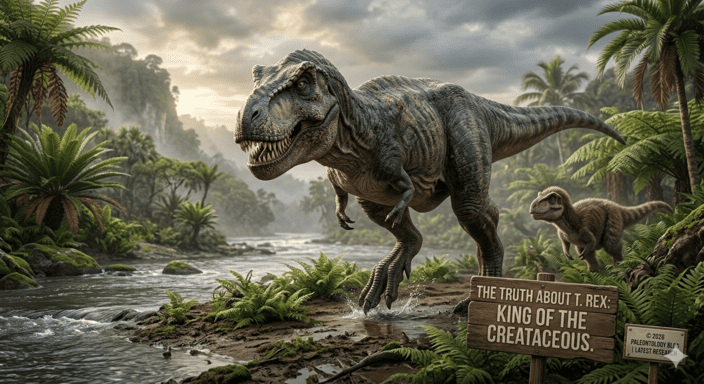
T. rex ruled the landmass known as Laramidia, that is now western North America and includes modern-day Montana, South Dakota, and Alberta, Canada. during the Late Cretaceous, roughly 68 to 66 million years ago. Its primary hunting grounds included dense coastal floodplains, open forested regions, and subtropical swamplands, particularly the famous Hell Creek Formation.
It coexisted with, and preyed upon, massive armored herbivore titans like Triceratops and Ankylosaurus, as well as large hadrosaurs like Edmontosaurus. This environment provided the massive amount of biomass required to sustain a multi-ton apex predator.
Behavior and Physical Attributes: A Smart and Social Killer?
Modern paleontology has shattered the image of T. rex as a slow, and as a simple scavenger. New research into endocasts (brain cases) indicates T. rex had a relatively large brain compared to other giant theropods, suggesting complex behaviors.
- Advanced Senses: Its olfactory bulbs were massive, providing an exceptional sense of smell, while its forward-facing eyes granted excellent binocular vision and depth perception—essential traits for an active hunter.
- Body: Tyrannosaurus rex was a large carnivorous theropod that walked on powerful hind legs and balanced its body with a long, heavy tail. Adults could reach more than 40 feet in length and weigh up to 15,000 pounds.
- Teeth: One of its most impressive features was its bite. T. rex possessed about 60 large serrated teeth, some measuring up to eight inches long. These teeth allowed it to crush bone and tear through flesh with incredible force.
- Social Hunting: Perhaps the most groundbreaking shift in 2026 thinking concerns social behavior. Fossil evidence of multiple T. rex individuals found together in bone beds strongly suggests they may have been social, perhaps even hunting in coordinated packs, particularly when targeting armored prey like Triceratops.
If you want to bring the ‘King of the Tyrants’ into your own home, check out our guide to the most realistic T. rex action figures and collector models of 2026.
Recent Discoveries and Interesting Facts
The last few years have been a golden age for T. rex research:
The Fuzz Fact: While adult T. rex were likely mostly scaly (due to gigantothermy), 2026 paleontology agrees that juveniles were likely covered in a light, downy coat of proto-feathers for insulation and camouflage, which they lost as they grew.
Bite Dynamics: Advanced computer modeling (published in 2025) finally explained how the T. rex skull could withstand its own immense bite force without shattering: its skull possessed key “kinetic” joints that allowed slight flexibility, absorbing the shocking impact of bone-crushing impacts.
The Tail Paradox: T. rex was once depicted with a dragging tail. It is now known that its muscular, heavy tail acted as a necessary counterbalance to its massive skull, held stiffly parallel to the ground for balance and stabilization during rapid turns.
New Beginnings: A 2025 study suggests the species may have evolved in North America after its ancestors migrated from Asia across an ancient land bridge millions of years earlier.
Great Growth: Scientists have also discovered more about how quickly the dinosaur grew. Recent studies of bone growth rings indicate that T. rex may have taken as long as 40 years to reach full size, longer than previously thought.
Tyrannosaurus rex is full of surprising traits that make it unique among dinosaurs:
- It had one of the strongest bite forces of any land animal in history.
- Its tiny arms remain a mystery—scientists still debate their purpose.
- Some of the most famous fossils include Sue and Scotty, two of the largest T. rex skeletons ever discovered.
- Despite its massive size, it likely relied heavily on smell and vision to locate prey.
Why T. Rex Still Captivates Scientists
Tyrannosaurus rex remains the defining apex predator of Earth’s history because it was a perfect optimization of power, intelligence, and sensory perception. It wasn’t just big; it was exceptionally well-adapted. As we continue to uncover its feathered past and social complexities, the true King of the Dinosaurs only becomes more fascinating.