Horns and Shields: Decoding the Defensive Secrets of the Triceratops

triceratops

​Among the most recognizable dinosaurs ever discovered, Triceratops stands as a symbol of the Late Cretaceous period and a favorite among fossil enthusiasts. Known for its three distinctive facial horns and large bony frill, this herbivorous giant roamed what is now North America roughly 68–66 million years ago. Fossils have been found primarily in the Hell Creek Formation, one of the richest dinosaur fossil sites in the world, helping scientists reconstruct the life and environment of this remarkable creature. Let’s dive into the world of this “three-horned face” giant.

​A Masterpiece of Evolution: Anatomy and Features

​The name Triceratops comes from the Greek words tri (three), keras (horn), and ops (face). Living approximately 68 to 66 million years ago during the Late Cretaceous, this dinosaur was a true powerhouse.It walked on four sturdy legs and belonged to a group of dinosaurs known as ceratopsians, characterized by their elaborate facial horns and bony frills.

  • The Horns: It possessed two long brow horns—which could reach up to 3 feet in length—and a shorter snout horn. While often depicted in cinematic battles against predators, these horns were likely used for both defense and courtship displays.
  • The Frill: The large bony frill protecting its neck wasn’t just armor. More recent thinking leans toward the idea that the frill played a social role — used for species recognition, attracting mates, or communicating dominance within a herd. It may also have been flushed with color in living animals, making it a vivid display structure rather than just a shield.
  • Size and Weight: A full-grown Triceratops could reach lengths of 26 to 30 feet and weigh anywhere from 6 to 12 tons—roughly the weight of two modern African elephants.

​Triceratops Diet: What Did a 12-Ton Herbivore Eat?

​Despite its intimidating appearance, the Triceratops was a dedicated herbivore. Because its head was positioned low to the ground, its diet primarily consisted of low-growing vegetation.

​Using its beak-like mouth and hundreds of “dental battery” teeth, it could easily shear through tough, fibrous plants like ferns, cycads, and palms. Unlike many other dinosaurs that swallowed stones to help grind food, the Triceratops’ teeth were self-sharpening and perfectly evolved for a heavy-duty plant-based diet.

​Triceratops vs. T-Rex: The Ultimate Rivalry

​The “clash of the titans” between the Triceratops and the T. rex isn’t just a Hollywood invention. Fossil evidence, including Triceratops bones with healed T. rex bite marks, suggests these two giants frequently crossed paths in the Hell Creek Formation of North America.

​The Triceratops was uniquely built to stand its ground. Its sturdy, four-legged stance provided a low center of gravity, making it incredibly difficult for a predator to topple.

Defensive Mechanisms: The Living Tank

The defensive arsenal of the Triceratops was a masterpiece of Cretaceous evolution. While its three horns—two brow horns reaching up to 3 feet long and one shorter nasal horn—were once thought to be primarily for show, 2026 biomechanical studies and fossil pathologies (combat scars) confirm they were used in high-intensity physical clashes. Analysis of lesions on the squamosal bone (the lower part of the frill) shows patterns consistent with “horn-locking” during battles with rivals or predators. The iconic bony frill acted as a protective shield for the vulnerable neck muscles, while its massive 10-ton body, supported by a fused “syncervical” neck structure, allowed it to absorb the impact of a charging Tyrannosaurus rex.

Recent Discoveries: “Triceratops Dreams”

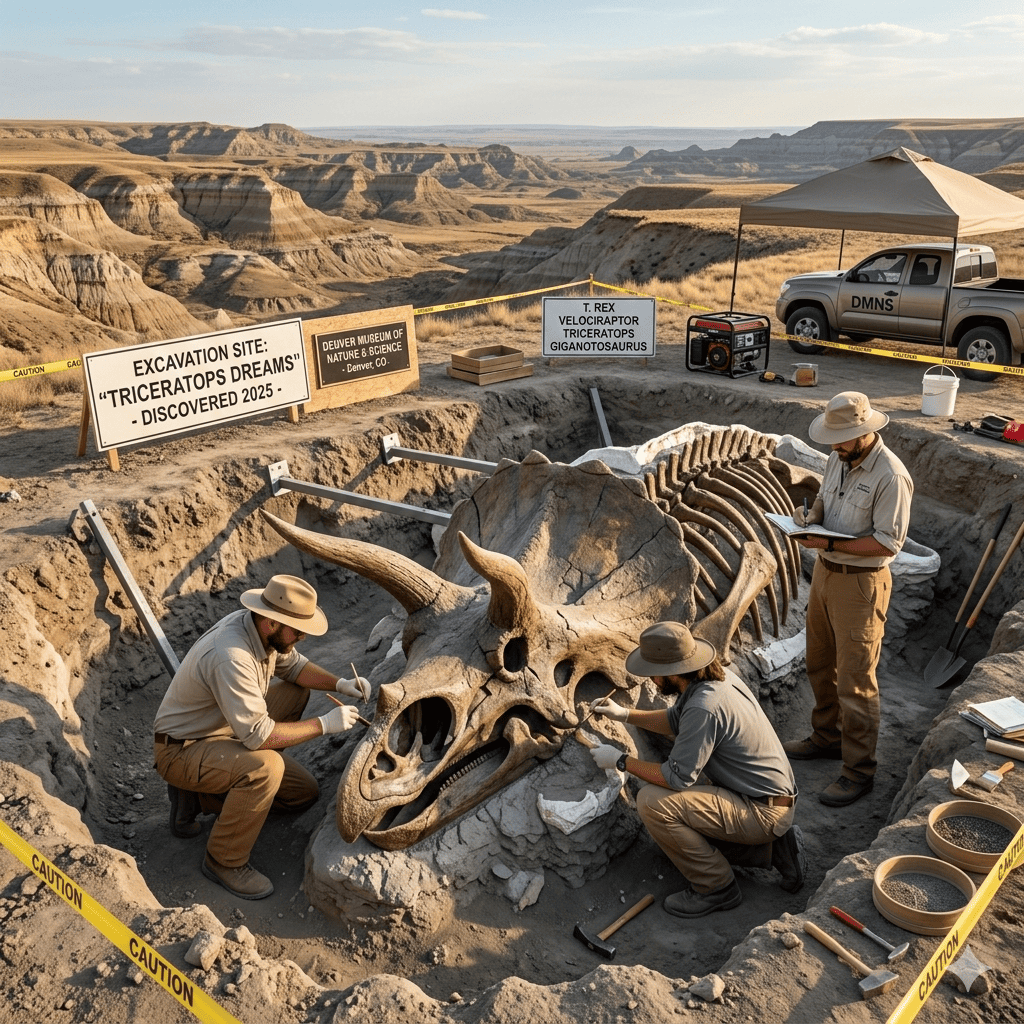
In late 2025 and early 2026, paleontology headlines were dominated by the excavation of a specimen nicknamed “Triceratops Dreams” in the Hell Creek Formation of North Dakota. This find is globally significant because it includes a nearly pristine, 5.4-ton block containing not just the skull, but the articulated neck and ribs. Such completeness is rare and is currently allowing researchers at the Denver Museum of Nature & Science to study growth patterns and horn development in unprecedented detail. Additionally, the specimen “Horridus” has recently provided the first clear look at a complete Triceratops tail, revealing that these animals were even more massive and elongated than previously estimated.

Habitat: The Lush Lowlands of Laramidia

Triceratops thrived on the island continent of Laramidia, specifically in the coastal lowlands and floodplain forests of what is now the American West (Montana, Wyoming, and the Dakotas). During the Late Cretaceous, this region was a warm, humid environment filled with swampy peripheries and lush inland forests. Triceratops acted as a “megagrazing” force, using its powerful, parrot-like beak to snip through tough, fibrous vegetation like cycads, ferns, and palms. Recent environmental reconstructions suggest they preferred these wetter, low-lying areas near the Western Interior Seaway, coexisting in a dense ecosystem with other famous giants like Edmontosaurus and Ankylosaurus.

​Fun Facts for Paleo-Enthusiasts

  1. Massive Skull: The Triceratops had one of the largest skulls of any land animal, sometimes making up nearly one-third of its entire body length.
  1. Solo or Social? While often thought of as solitary, recent fossil discoveries of “bone beds” suggest that younger Triceratops might have traveled in small groups.
  1. The “Torosaurus” Debate: For years, paleontologists debated whether Torosaurus was a separate species or simply an elderly Triceratops with an expanded frill. Current consensus generally leans toward them being distinct species.

​The Triceratops remains a symbol of the prehistoric world’s diversity and resilience. Whether it was defending its territory or grazing through ancient marshes, this horned giant continues to capture our imagination millions of years after it vanished.
Everything Dino: A Fun and Fascinating Dino World

everything dino

Everything Dino: A Fun and Fascinating Dino World

Welcome, future paleontologists and dinosaur enthusiasts, to the only website you’ll ever need for everything dino! If you’ve ever gazed in wonder at the sheer scale of a Tyrannosaurus Rex or been captivated by the swift grace of a Velociraptor, you’ve found your digital home. We are passionate about bringing the prehistoric world back to life through engaging content, up-to-date news, and a vibrant community dedicated to these magnificent creatures. Prepare to embark on an incredible journey through time, right from your screen!

Our mission is to be your most comprehensive guide to the Mesozoic Era, covering everything dino from the smallest Microraptor to the colossal Argentinosaurus. We understand the fascination these ancient beasts hold, and we’ve built this site to feed that curiosity. Whether you’re a budding young enthusiast sketching your favorite carnivores or a seasoned expert keeping tabs on the latest research, there’s a trove of information and entertainment waiting for you here.

One of the most popular sections on any dinosaur site often revolves around dino fun facts. These bite-sized pieces of information are perfect for quick learning and sharing. Readers might discover how some dinosaurs had feathers, how long certain species lived, or how paleontologists can estimate a dinosaur’s speed from footprints. Trex fun facts are especially popular, as Tyrannosaurus rex remains one of the most iconic dinosaurs of all time. From its powerful bite force to ongoing debates about its hunting behavior, T. rex facts never fail to impress and surprise.

The fascination with everything dino extends far beyond paleontology and into the vibrant world of media, where these prehistoric giants have captivated audiences for over a century. From the groundbreaking CGI spectacle of the Jurassic Park franchise to the heartwarming animated adventures of The Land Before Time, movies and television constantly reimagine the age of dinosaurs, sometimes with scientific accuracy and sometimes purely for thrill. Beyond the screen, a rich library of dinosaur books—encompassing everything from educational reference guides to speculative fiction novels—continues to fuel the imagination, ensuring the legacy and roar of these incredible creatures live on in popular culture.

For the younger explorers and collectors at heart, we have an extensive section dedicated to dino toys. Dive into reviews of the latest action figures, learn about educational playsets, and discover classic collectibles that bring the roar and stomp of dinosaurs into your living room. We’ll help you navigate the vast array of options to find the perfect gift or addition to your own prehistoric menagerie, ensuring endless hours of imaginative play.

Beyond your personal collection, we track the best places to experience these giants up close. Our frequently updated guide to dino exhibits, dino museums, and dino theme parks will point you towards the most breathtaking museum displays, immersive interactive experiences, and even real-life fossil digs happening near you or around the world. Imagine standing beneath a towering skeleton or seeing a meticulously reconstructed ancient landscape – we’ll help you plan your next unforgettable adventure.

We also keep a keen eye on the cutting edge of paleontology. Our dino discoveries section brings you the latest news from archaeological digs and scientific breakthroughs. Read about newly identified species, groundbreaking theories on dinosaur extinction, and advanced technologies that are helping scientists uncover more about these ancient rulers of Earth. It’s a dynamic field, and we’re here to ensure you don’t miss a single seismic revelation.

So, whether you’re here to find the perfect dino toys, plan your next visit to spectacular dino exhibits, delve into amazing dino fun facts, stay updated on the latest dino discoveries, or simply immerse yourself in everything dino, you’ve arrived at your ultimate prehistoric portal. Explore, learn, and let your imagination roam freely across millions of years of Earth’s most incredible history!

Fascinating Velociraptor Facts You Need to Know

velociraptor

When you hear the word “Velociraptor,” your mind probably jumps to the towering, scaly predators of Hollywood fame. However, the real Velociraptor mongoliensis was a very different—and in many ways, more fascinating—creature. In the world of 2026 paleontology, we now recognize the Velociraptor not as a monster from a movie, but as a highly specialized, feathered, and intelligent hunter that prowled the deserts of prehistoric Asia. These small but formidable predators lived around 75 million years ago during the Late Cretaceous period. Fossils show they roamed ancient desert regions of what is now the Gobi Desert in modern-day Mongolia, where shifting sands helped preserve their remains for millions of years.

If seeing these feathered predators in person is on your bucket list, you can track down the most life-like skeletons and interactive displays in our guide to the best dino destinations, including museums, exhibits, and attractions.

The Size Myth: Real-Life Raptors vs. Cinema

One of the most common misconceptions is the size of the Velociraptor. While movies often depict them as being as tall as a human, the actual dinosaur was roughly the size of a large turkey. It stood about 0.5 meters (1.6 feet) tall at the hip and reached lengths of 2 meters (6.6 feet) from snout to tail-tip.

Despite its smaller stature, it was an apex predator for its size. Weighing in at approximately 15 to 20 kilograms (33-44 pounds), it was built for speed, agility, and precision strikes rather than brute force.

Feathers and Flightless Wings

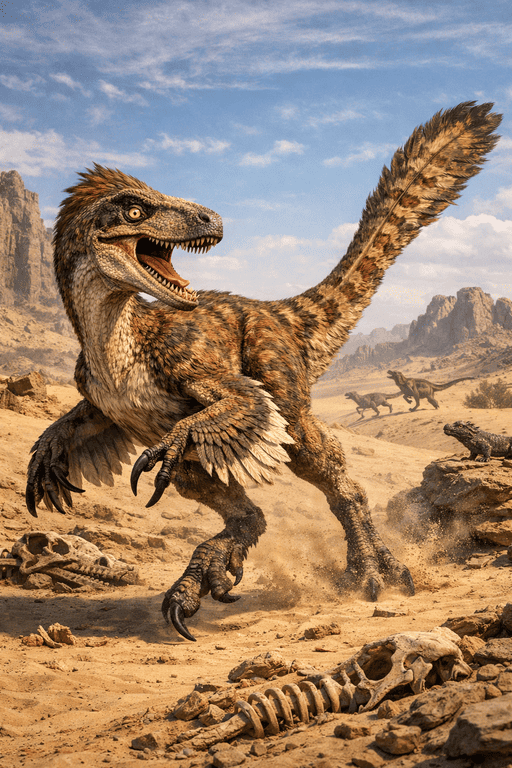
The most striking visual difference between the real Velociraptor and its pop-culture counterpart is the presence of feathers. Fossil evidence, including “quill knobs” found on the ulna (forearm bone), confirms that Velociraptors were covered in bird-like plumage.

While they couldn’t fly, these feathers likely served several purposes:

  • Thermoregulation: Keeping the dinosaur warm in the fluctuating temperatures of the Gobi Desert.
  • Display: Using vibrant plumage to attract mates or intimidate rivals.
  • Stability: Helping the predator maintain balance while pinning down struggling prey.

The Deadly “Sickle Claw”

The Velociraptor’s most iconic feature is the oversized, retractable sickle-shaped claw on the second toe of each foot. For a long time, it was believed these claws were used to disembowel prey. However, modern biomechanical studies suggest they were used more like “crampons”—to pierce the neck or vital organs and to grip the prey firmly while the dinosaur used its sharp teeth to finish the job. This sickle-shaped talon could grow up to 3 inches long.

Intelligence and Hunting Tactics

Were they pack hunters? Scientists are still in debate over this. While evidence of social behavior in related dromaeosaurs exists, the Velociraptor is often found as a solitary hunter. The famous “Fighting Dinosaurs” fossil—which captures a Velociraptor and a Protoceratops locked in a death struggle—shows a one-on-one battle. This suggests they were brave and capable of taking down prey much bulkier than themselves. Velociraptors were carnivores that hunted small animals, reptiles, and possibly other dinosaurs. Fossil discoveries suggest they were active hunters rather than scavengers. Regardless, their sharp teeth, grasping hands, and strong legs made them highly effective predators for their size.

Why the Velociraptor Still Captivates Us

The Velociraptor represents the perfect bridge between dinosaurs and modern birds. It was a fast, smart, and lethal predator that proved you didn’t need to be the size of a T. rex to be a legend. As we continue to uncover more about their feathered lives, the Velociraptor remains a testament to the incredible diversity and “cool factor” of the Cretaceous period.

Discovery and Scientific Significance

The first velociraptor fossil was discovered in 1923 during an expedition led by the American Museum of Natural History. Since then, additional finds have helped scientists better understand their anatomy, growth, and evolutionary relationship to modern birds.

Recent Discoveries

Recent years have brought a wave of “raptor” excitement, most notably with the 2025 and early 2026 analysis of Shri rapax, a close cousin of Velociraptor mongoliensis from the same Gobi Desert formations. While the original Velociraptor was built for speed and likely used its feet to pin down prey, discoveries of this new relative reveal a much more “rapacious” hunter with exceptionally robust hands and arm bones nearly 150% thicker than its cousins. This suggests a fascinating era of “niche partitioning,” where Velociraptor may have focused on smaller, swifter lizards while its more muscular relatives like Shri used pure grip strength to grapple with larger, tougher herbivores like Protoceratops. Furthermore, the 2026 identification of dromaeosaurid teeth in Serbia has confirmed that these agile predators were much more geographically widespread than previously thought, inhabiting vibrant island ecosystems across prehistoric Europe.

Dying to rock some velociraptor merch? Here’s our guide to dino clothing, merch, and accessories.

Velociraptor: Myth vs. Fact

FeatureThe Hollywood MythThe Paleontology Fact
SizeHuman-sized or larger (approx. 6ft tall).Size of a turkey (approx. 1.6ft tall at the hip).
SkinScaly, reptilian skin like a lizard.Covered in bird-like feathers with quill knobs.
IntelligenceCapable of opening doors and complex puzzles.High for a dinosaur, likely on par with modern smart birds or crows.
HuntingAlways hunted in large, coordinated packs.Primarily a solitary hunter or small family groups.
The ClawUsed for disemboweling and “slashing” prey.Used for pinning and piercing vital areas (neck/windpipe).
SpeedCould outrun a car or a cheetah.Fast, but clocked at roughly 25 mph (40 kph).