Among the most recognizable dinosaurs ever discovered, Triceratops stands as a symbol of the Late Cretaceous period and a favorite among fossil enthusiasts. Known for its three distinctive facial horns and large bony frill, this herbivorous giant roamed what is now North America roughly 68–66 million years ago. Fossils have been found primarily in the Hell Creek Formation, one of the richest dinosaur fossil sites in the world, helping scientists reconstruct the life and environment of this remarkable creature. Let’s dive into the world of this “three-horned face” giant.
A Masterpiece of Evolution: Anatomy and Features
The name Triceratops comes from the Greek words tri (three), keras (horn), and ops (face). Living approximately 68 to 66 million years ago during the Late Cretaceous, this dinosaur was a true powerhouse.It walked on four sturdy legs and belonged to a group of dinosaurs known as ceratopsians, characterized by their elaborate facial horns and bony frills.
- The Horns: It possessed two long brow horns—which could reach up to 3 feet in length—and a shorter snout horn. While often depicted in cinematic battles against predators, these horns were likely used for both defense and courtship displays.
- The Frill: The large bony frill protecting its neck wasn’t just armor. More recent thinking leans toward the idea that the frill played a social role — used for species recognition, attracting mates, or communicating dominance within a herd. It may also have been flushed with color in living animals, making it a vivid display structure rather than just a shield.
- Size and Weight: A full-grown Triceratops could reach lengths of 26 to 30 feet and weigh anywhere from 6 to 12 tons—roughly the weight of two modern African elephants.
Triceratops Diet: What Did a 12-Ton Herbivore Eat?
Despite its intimidating appearance, the Triceratops was a dedicated herbivore. Because its head was positioned low to the ground, its diet primarily consisted of low-growing vegetation.
Using its beak-like mouth and hundreds of “dental battery” teeth, it could easily shear through tough, fibrous plants like ferns, cycads, and palms. Unlike many other dinosaurs that swallowed stones to help grind food, the Triceratops’ teeth were self-sharpening and perfectly evolved for a heavy-duty plant-based diet.
Triceratops vs. T-Rex: The Ultimate Rivalry
The “clash of the titans” between the Triceratops and the T. rex isn’t just a Hollywood invention. Fossil evidence, including Triceratops bones with healed T. rex bite marks, suggests these two giants frequently crossed paths in the Hell Creek Formation of North America.
The Triceratops was uniquely built to stand its ground. Its sturdy, four-legged stance provided a low center of gravity, making it incredibly difficult for a predator to topple.
Defensive Mechanisms: The Living Tank
The defensive arsenal of the Triceratops was a masterpiece of Cretaceous evolution. While its three horns—two brow horns reaching up to 3 feet long and one shorter nasal horn—were once thought to be primarily for show, 2026 biomechanical studies and fossil pathologies (combat scars) confirm they were used in high-intensity physical clashes. Analysis of lesions on the squamosal bone (the lower part of the frill) shows patterns consistent with “horn-locking” during battles with rivals or predators. The iconic bony frill acted as a protective shield for the vulnerable neck muscles, while its massive 10-ton body, supported by a fused “syncervical” neck structure, allowed it to absorb the impact of a charging Tyrannosaurus rex.
Recent Discoveries: “Triceratops Dreams”
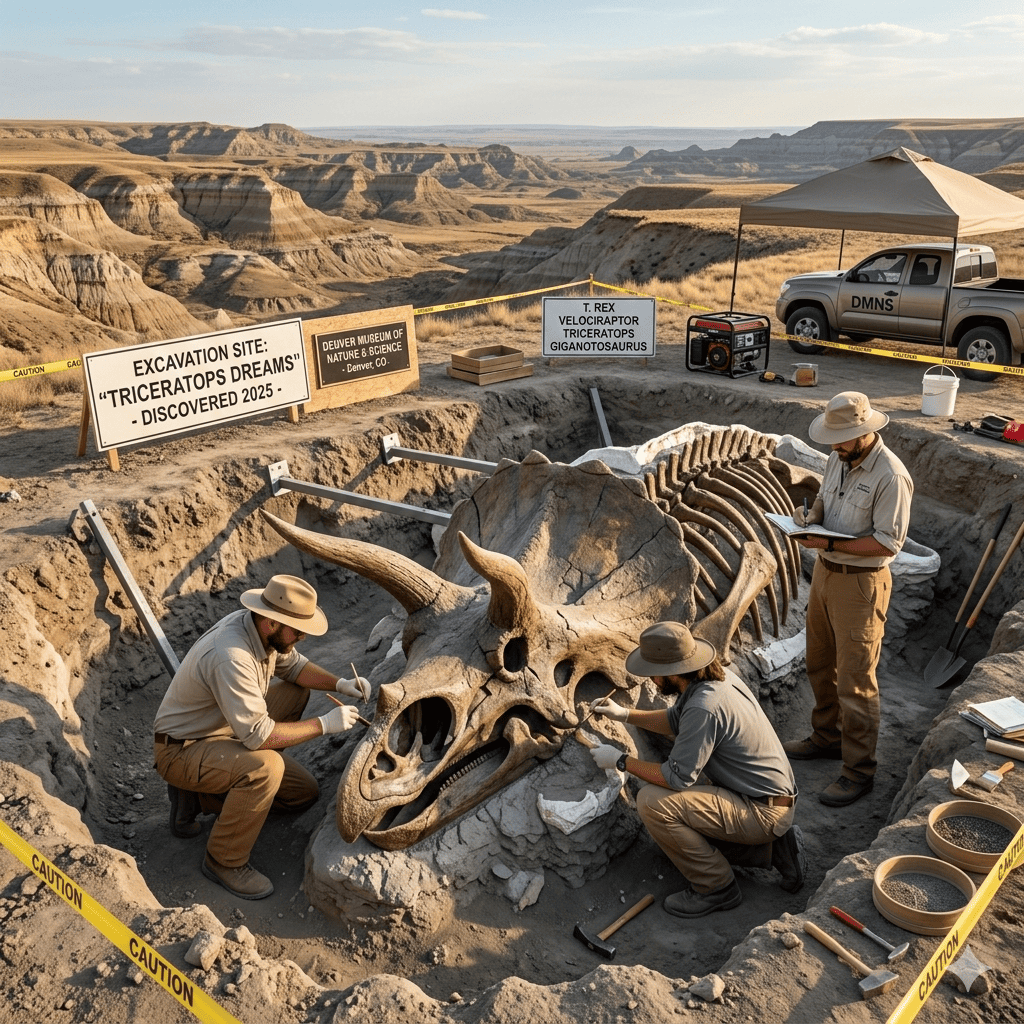
In late 2025 and early 2026, paleontology headlines were dominated by the excavation of a specimen nicknamed “Triceratops Dreams” in the Hell Creek Formation of North Dakota. This find is globally significant because it includes a nearly pristine, 5.4-ton block containing not just the skull, but the articulated neck and ribs. Such completeness is rare and is currently allowing researchers at the Denver Museum of Nature & Science to study growth patterns and horn development in unprecedented detail. Additionally, the specimen “Horridus” has recently provided the first clear look at a complete Triceratops tail, revealing that these animals were even more massive and elongated than previously estimated.
Habitat: The Lush Lowlands of Laramidia
Triceratops thrived on the island continent of Laramidia, specifically in the coastal lowlands and floodplain forests of what is now the American West (Montana, Wyoming, and the Dakotas). During the Late Cretaceous, this region was a warm, humid environment filled with swampy peripheries and lush inland forests. Triceratops acted as a “megagrazing” force, using its powerful, parrot-like beak to snip through tough, fibrous vegetation like cycads, ferns, and palms. Recent environmental reconstructions suggest they preferred these wetter, low-lying areas near the Western Interior Seaway, coexisting in a dense ecosystem with other famous giants like Edmontosaurus and Ankylosaurus.
Fun Facts for Paleo-Enthusiasts
- Massive Skull: The Triceratops had one of the largest skulls of any land animal, sometimes making up nearly one-third of its entire body length.
- Solo or Social? While often thought of as solitary, recent fossil discoveries of “bone beds” suggest that younger Triceratops might have traveled in small groups.
- The “Torosaurus” Debate: For years, paleontologists debated whether Torosaurus was a separate species or simply an elderly Triceratops with an expanded frill. Current consensus generally leans toward them being distinct species.
The Triceratops remains a symbol of the prehistoric world’s diversity and resilience. Whether it was defending its territory or grazing through ancient marshes, this horned giant continues to capture our imagination millions of years after it vanished.