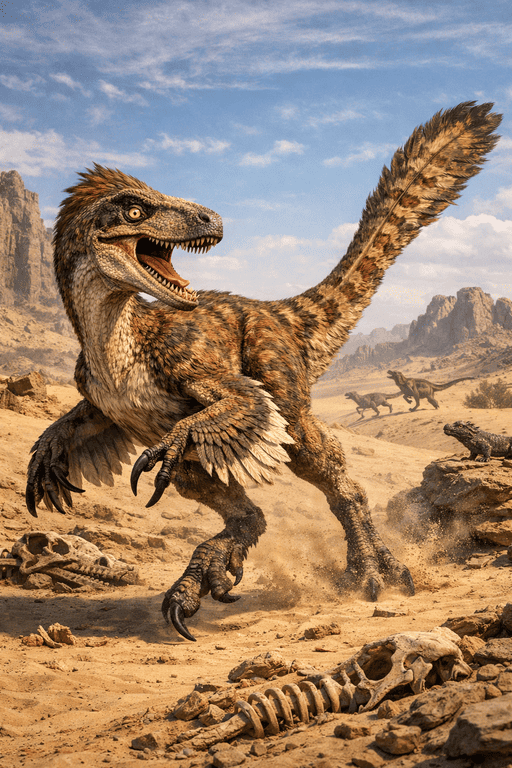
When you hear the word “Velociraptor,” your mind probably jumps to the towering, scaly predators of Hollywood fame. However, the real Velociraptor mongoliensis was a very different—and in many ways, more fascinating—creature. In the world of 2026 paleontology, we now recognize the Velociraptor not as a monster from a movie, but as a highly specialized, feathered, and intelligent hunter that prowled the deserts of prehistoric Asia. These small but formidable predators lived around 75 million years ago during the Late Cretaceous period. Fossils show they roamed ancient desert regions of what is now the Gobi Desert in modern-day Mongolia, where shifting sands helped preserve their remains for millions of years.
If seeing these feathered predators in person is on your bucket list, you can track down the most life-like skeletons and interactive displays in our guide to the best dino destinations, including museums, exhibits, and attractions.
The Size Myth: Real-Life Raptors vs. Cinema
One of the most common misconceptions is the size of the Velociraptor. While movies often depict them as being as tall as a human, the actual dinosaur was roughly the size of a large turkey. It stood about 0.5 meters (1.6 feet) tall at the hip and reached lengths of 2 meters (6.6 feet) from snout to tail-tip.
Despite its smaller stature, it was an apex predator for its size. Weighing in at approximately 15 to 20 kilograms (33-44 pounds), it was built for speed, agility, and precision strikes rather than brute force.
Feathers and Flightless Wings
The most striking visual difference between the real Velociraptor and its pop-culture counterpart is the presence of feathers. Fossil evidence, including “quill knobs” found on the ulna (forearm bone), confirms that Velociraptors were covered in bird-like plumage.
While they couldn’t fly, these feathers likely served several purposes:
- Thermoregulation: Keeping the dinosaur warm in the fluctuating temperatures of the Gobi Desert.
- Display: Using vibrant plumage to attract mates or intimidate rivals.
- Stability: Helping the predator maintain balance while pinning down struggling prey.
The Deadly “Sickle Claw”
The Velociraptor’s most iconic feature is the oversized, retractable sickle-shaped claw on the second toe of each foot. For a long time, it was believed these claws were used to disembowel prey. However, modern biomechanical studies suggest they were used more like “crampons”—to pierce the neck or vital organs and to grip the prey firmly while the dinosaur used its sharp teeth to finish the job. This sickle-shaped talon could grow up to 3 inches long.
Intelligence and Hunting Tactics
Were they pack hunters? Scientists are still in debate over this. While evidence of social behavior in related dromaeosaurs exists, the Velociraptor is often found as a solitary hunter. The famous “Fighting Dinosaurs” fossil—which captures a Velociraptor and a Protoceratops locked in a death struggle—shows a one-on-one battle. This suggests they were brave and capable of taking down prey much bulkier than themselves. Velociraptors were carnivores that hunted small animals, reptiles, and possibly other dinosaurs. Fossil discoveries suggest they were active hunters rather than scavengers. Regardless, their sharp teeth, grasping hands, and strong legs made them highly effective predators for their size.
Why the Velociraptor Still Captivates Us
The Velociraptor represents the perfect bridge between dinosaurs and modern birds. It was a fast, smart, and lethal predator that proved you didn’t need to be the size of a T. rex to be a legend. As we continue to uncover more about their feathered lives, the Velociraptor remains a testament to the incredible diversity and “cool factor” of the Cretaceous period.
Discovery and Scientific Significance
The first velociraptor fossil was discovered in 1923 during an expedition led by the American Museum of Natural History. Since then, additional finds have helped scientists better understand their anatomy, growth, and evolutionary relationship to modern birds.
Recent Discoveries
Recent years have brought a wave of “raptor” excitement, most notably with the 2025 and early 2026 analysis of Shri rapax, a close cousin of Velociraptor mongoliensis from the same Gobi Desert formations. While the original Velociraptor was built for speed and likely used its feet to pin down prey, discoveries of this new relative reveal a much more “rapacious” hunter with exceptionally robust hands and arm bones nearly 150% thicker than its cousins. This suggests a fascinating era of “niche partitioning,” where Velociraptor may have focused on smaller, swifter lizards while its more muscular relatives like Shri used pure grip strength to grapple with larger, tougher herbivores like Protoceratops. Furthermore, the 2026 identification of dromaeosaurid teeth in Serbia has confirmed that these agile predators were much more geographically widespread than previously thought, inhabiting vibrant island ecosystems across prehistoric Europe.
Dying to rock some velociraptor merch? Here’s our guide to dino clothing, merch, and accessories.
Velociraptor: Myth vs. Fact
| Feature | The Hollywood Myth | The Paleontology Fact |
| Size | Human-sized or larger (approx. 6ft tall). | Size of a turkey (approx. 1.6ft tall at the hip). |
| Skin | Scaly, reptilian skin like a lizard. | Covered in bird-like feathers with quill knobs. |
| Intelligence | Capable of opening doors and complex puzzles. | High for a dinosaur, likely on par with modern smart birds or crows. |
| Hunting | Always hunted in large, coordinated packs. | Primarily a solitary hunter or small family groups. |
| The Claw | Used for disemboweling and “slashing” prey. | Used for pinning and piercing vital areas (neck/windpipe). |
| Speed | Could outrun a car or a cheetah. | Fast, but clocked at roughly 25 mph (40 kph). |